Supercomputers in the WeatherGenerator
What are Supercomputers?
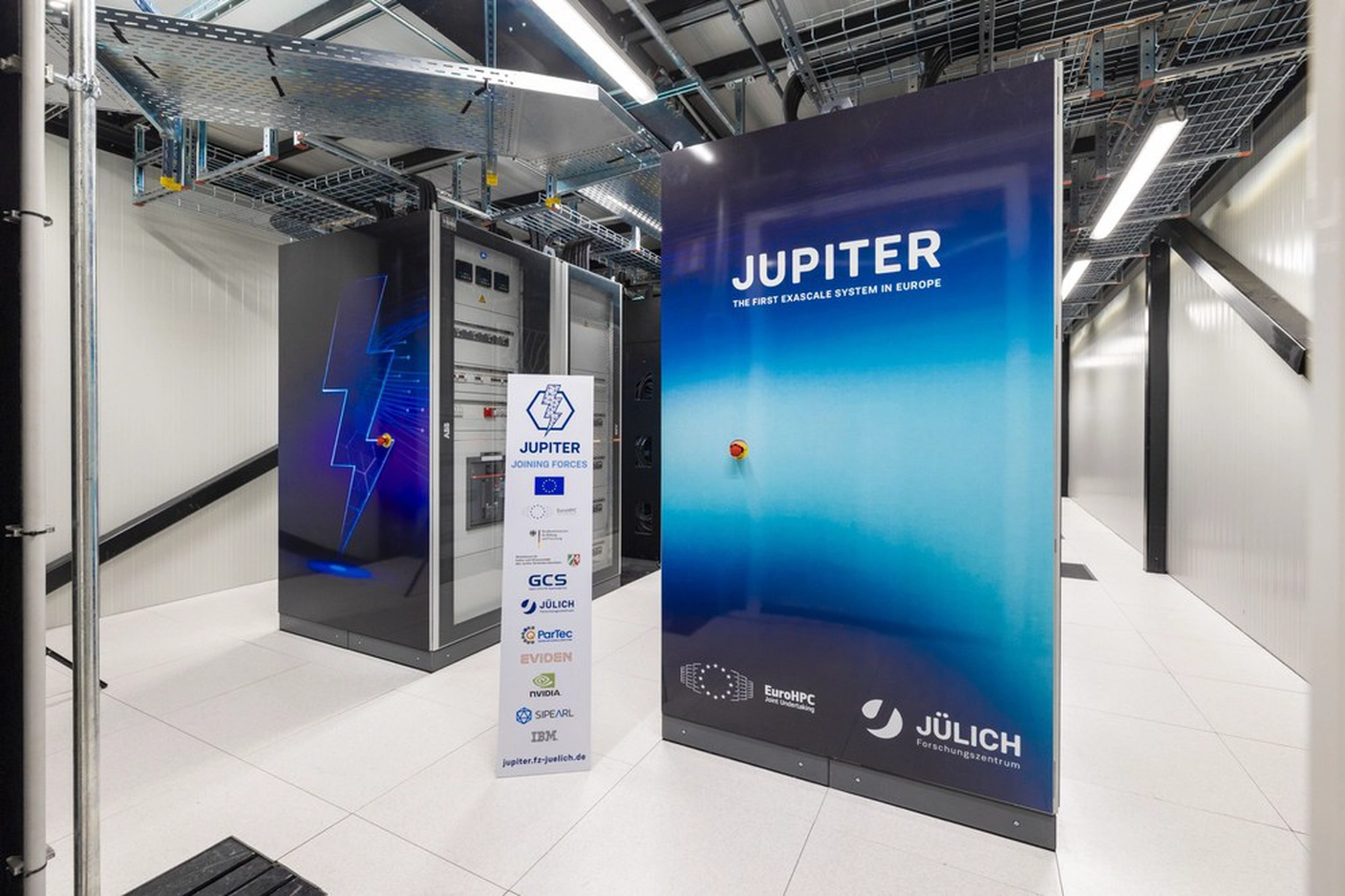
Supercomputers are high-performance computing systems designed to solve problems which exceed the capacity of conventional machines. Their defining feature is massive parallelism: instead of relying on a single processor, they connect tens of thousands of CPUs and GPUs which perform calculations simultaneously. This parallel architecture allows them to reach speeds measured in petaflops (10¹⁵ operations per second) or even exaflops (10¹⁸ operations per second), enabling computations that would take years on a standard computer to be completed within hours or days.
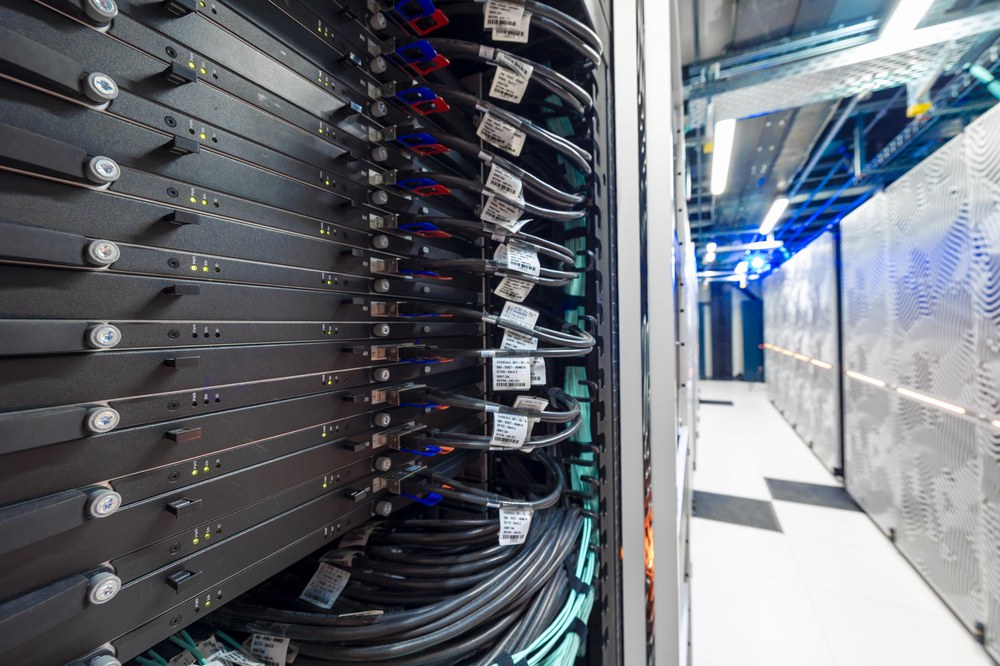
To operate at such scales, supercomputers are structured into compute nodes: individual units containing processors, memory, and networking interfaces. These nodes are linked through high-bandwidth, low-latency interconnects, allowing data to move efficiently between processors. Specialized scheduling software distributes large scientific problems into smaller tasks, which can then be solved simultaneously and recombined into a complete result. Because of the enormous energy requirements, supercomputers also depend on advanced cooling and power management systems to maintain stability.
Application in the WeatherGenerator
WeatherGenerator uses supercomputers to represent a fundamentally different approach to Earth system modeling. This requires unprecedented computational resources. Unlike conventional weather models that solve physical equations step by step, WeatherGenerator is a Foundation Model with billions of parameters. These must be trained on petabytes of diverse datasets spanning observations, reanalyses, and high-resolution simulations from multiple sources. The model’s multi-resolution structure and its ability to fuse heterogeneous data streams from satellites, radar, weather stations, and model outputs, creates computational demands that requires the largest supercomputers available. Additionally, the project aims to perform online learning directly from DestinE’s Climate and Extremes Digital Twins as they run operationally. This requires real-time processing of enormous data volumes. Such processing would be impossible without the high-performance computing infrastructure provided by Europe’s EuroHPC machines and specialized systems like JUPITER at Jülich.
Introducing JUPITER at Jülich Research Centre
On September 5th, 2025, the WeatherGenerator’s project partner Jülich Research Centre introduced Europe’s newest and most powerful supercomputer, JUPITER. JUPITER is the first European computer to cross the exascale threshold: it can perform over one quintillion (10¹⁸) operations per second. This makes it the fourth-fastest supercomputer in the world while also ranking first in energy efficiency.
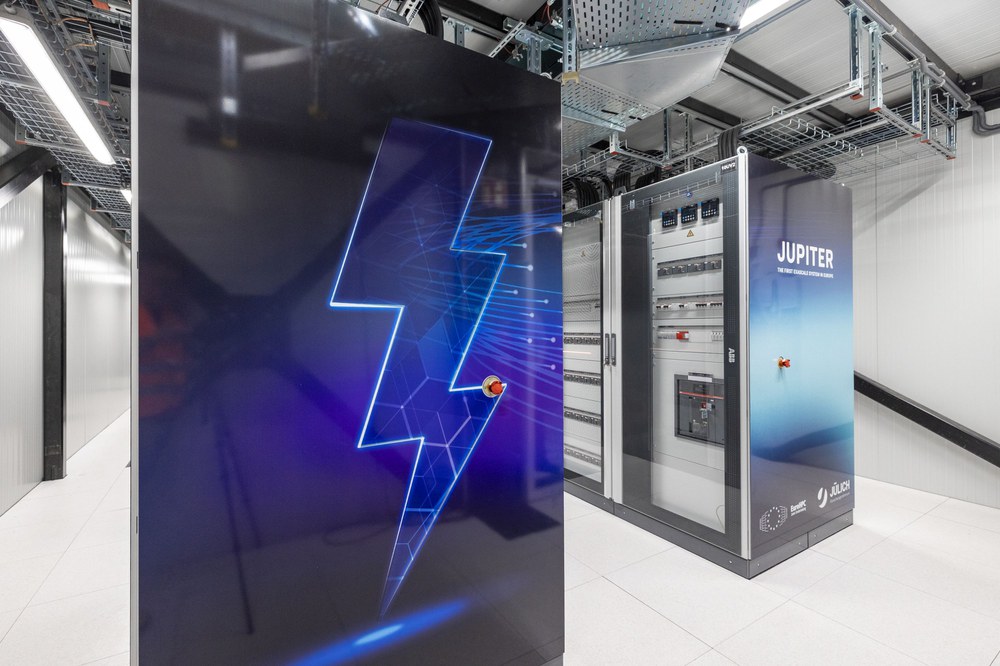
For WeatherGenerator, JUPITER opens entirely new horizons. Traditional weather models have typically worked with grid resolutions of around 10 kilometers, limiting their ability to capture local phenomena like individual storm cells or detailed cloud dynamics. With JUPITER, the physical weather and climate models of DestinE can be refined to the kilometer scale, creating priceless training data for projects such as WeatherGenerator as they resolve cloud structures, wind flow around topography, and precipitation patterns with unprecedented accuracy. WeatherGenerator will also tap into Jupiter’s breakthrough in computational power to build machine learning tools that open a new era for weather and climate predictions as they lead to better predictions of weather and climate, and science gains that will help us to face the challenges of our time.
Images: © Forschungszentrum Jülich / Sascha Kreklau